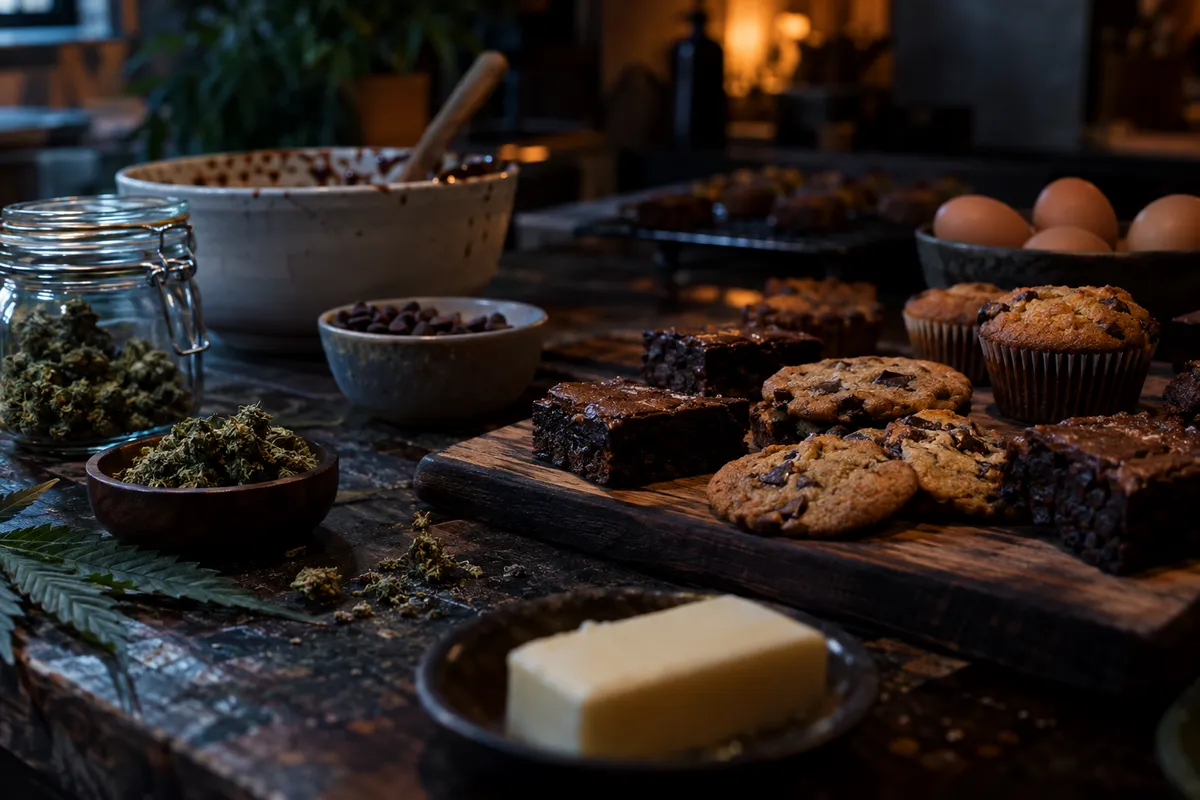
One homemade brownie feels barely noticeable, while another from the same pan turns a quiet evening into a much bigger commitment than you planned. Uneven homemade edibles are frustrating because several different problems can look identical: cannabinoids may be distributed unevenly, portions may differ in size, your starting ingredient may be less predictable than you assumed, or the circumstances of consumption may have changed. The fix isn’t simply “stir more” - although your spatula may have some explaining to do - but a repeatable process that separates batch strength, portion consistency, and personal experience, so you can troubleshoot what actually went wrong instead of guessing at the next tray.
Why are my homemade edibles unevenly potent, and how can I make them more consistent?
Homemade edibles can be unevenly potent because cannabinoids aren’t distributed uniformly, servings contain different amounts of infused ingredients, or the starting material has uncertain potency. Improve consistency by using a well-characterized ingredient, mixing it thoroughly into a compatible base, weighing portions, and recording your process; remember that equally potent servings can still feel different on different occasions.
Think of consistency as three separate jobs:
- Know the input: Understand what you can reasonably estimate about the infused ingredient’s strength.
- Distribute it evenly: Keep that ingredient dispersed throughout the food.
- Divide it accurately: Make servings that contain comparable amounts of the finished mixture.
Here’s a quick troubleshooting guide:
| What you notice | A possible explanation | A practical improvement |
|---|---|---|
| Oily streaks or greasy pockets | Infused fat wasn’t fully incorporated | Blend the fat into a compatible ingredient before combining |
| Large differences between servings | Unequal portions or uneven distribution | Weigh portions and improve mixing |
| Entire batches vary in strength | Starting potency or preparation changed | Standardize ingredients and document each batch |
| A drink separates while standing | Oil and water aren’t staying dispersed | Use an ingredient formulated for beverages |
| Similar servings feel different | Timing, food, recent use, or other circumstances changed | Log the context rather than assuming a mixing failure |
These clues aren’t proof. A stronger-feeling corner piece doesn’t establish a “hot spot,” and a smooth-looking batter doesn’t establish uniform potency. Appearance can reveal problems, but only appropriate testing can establish cannabinoid content.
Consistency starts before the mixing bowl
Your finished edible can only be as predictable as the ingredient going into it. If you begin with homemade infused butter of unknown strength, careful portioning can improve uniformity - but it cannot tell you exactly how much THC each serving contains.
Where legal and available, a regulated, tested ingredient with clearly stated cannabinoid content provides a more useful starting point than an unlabeled infusion. Check whether the label lists THC per container, per serving, or per unit of weight or volume. Those aren’t interchangeable.
With homemade infusions, uncertainty can enter through several doors:
- Starting material: Different flower batches can have different cannabinoid concentrations.
- Preparation: Changes in decarboxylation and infusion conditions can change the result.
- Ingredient recovery: Fat left behind in plant material or equipment affects what reaches your recipe.
- Storage and handling: Separation or deterioration can make an ingredient less predictable.
Decarboxylation affects activation, but uneven activation and uneven mixing are separate problems. Better mixing won’t correct inconsistent preparation. If you’re comparing preparation methods, this guide to grinding before or after decarb explains another variable worth keeping consistent.
For repeat batches, use the same ingredient source when possible, measure the amount added, and record any changes. “About the same spoonful” is a fine approach to cinnamon. It’s a shaky foundation for estimating cannabinoid content.
Better mixing prevents concentrated pockets
Cannabinoids such as THC are fat-soluble and don’t dissolve readily in water. That matters because an infused oil can blend reasonably well into a fatty batter while separating in lemonade, gelatin, or another water-heavy mixture.
Match the infused ingredient to the food. An oil that behaves well in cookie dough isn’t automatically suitable for a beverage. For drinks, use a product specifically formulated for that application rather than assuming vigorous shaking creates a stable mixture.
For fat-based baking, the goal is thorough incorporation without damaging the recipe’s texture:
- Prepare the infused fat uniformly. It should be evenly softened or melted as the recipe requires, rather than a mix of hard chunks and liquid.
- Blend it into a compatible ingredient first. Combine it thoroughly with the recipe’s other fat or an appropriate wet mixture before adding dry ingredients.
- Scrape the bowl and utensils. Concentrated residue on the sides, bottom, or spatula can re-enter the mixture late.
- Check for visible streaks or pools. Their presence signals incomplete mixing; their absence isn’t proof of uniformity.
- Portion before separation develops. If the mixture separates while standing, the first and last servings may differ.
For flour-based recipes, distribute the infused ingredient during the appropriate fat or wet-mixing stage. Trying to fix poor distribution by aggressively beating finished batter can produce tough baked goods without guaranteeing even potency.
Be cautious with infused toppings, too. Drizzling oil over a finished tray or adding separate blobs of infused frosting creates another distribution problem. The topping needs its own consistent mixing and portioning process.
Equal portions need a scale and a plan
Even a uniformly mixed batch produces unequal servings if the pieces differ substantially in size. A small edge sliver and a giant center square aren’t equivalent just because both qualify as “one brownie.”
A kitchen scale helps make portions more consistent. For cookies or other individually portioned foods, weigh the mixed dough into equal amounts before baking. For a pan bake, cut a planned grid and compare finished portion weights rather than relying entirely on eyesight.
There’s an important limitation: equal weight only approximates equal cannabinoid content when the infused ingredient is distributed uniformly. Moisture differences, uneven toppings, and concentrated inclusions can still complicate the comparison.
Treat potency calculations as estimates
Suppose a recipe contains an estimated 100 mg of THC and makes 20 equal portions. The arithmetic gives 5 mg per portion on average.
That calculation does not prove that every piece contains 5 mg. It assumes the input estimate is accurate, the cannabinoid-containing ingredient is distributed evenly, and losses during preparation are negligible. With an uncertain homemade infusion, the uncertainty carries through to every serving.
Label that distinction honestly: “Estimated 5 mg THC per piece” communicates something different from a tested result.
Write down the batch date, ingredient source, estimated total cannabinoid content, number of portions, and portion weight. Keep infused foods clearly separated from ordinary snacks and secured away from children and pets. For practical labeling and storage habits, see edible safety and responsible use.
Your future self should never have to play “regular banana bread or infused banana bread?” at the freezer.
Different experiences don’t always mean different potency
Two similarly prepared servings can feel different without either one being a mixing failure. Food intake, time of day, recent cannabis use, individual variation, and other substances can all influence the experience or how you perceive it.
Edibles also have a delayed onset, and their effects can continue developing after you first notice them. Taking more because a serving seems weak can turn a timing issue into an unexpectedly intense experience. Avoid using rapid repeat consumption as a homemade potency test.
Instead, keep two kinds of notes:
Batch notes describe the food: ingredient source, estimated cannabinoid input, mixing method, portion weight, storage, and preparation changes.
Session notes describe the circumstances: amount consumed, time, food timing, other cannabis or alcohol use, when effects became noticeable, and your subjective experience.
Keeping these separate helps prevent mistaken conclusions. If multiple servings vary despite similar circumstances, investigate preparation and portioning. If the same batch feels different across very different circumstances, don’t automatically blame the batter.
Neither pattern establishes a serving’s actual cannabinoid content. Personal experience is useful feedback, not a laboratory assay.
For troubleshooting, change one production variable at a time. Keep the recipe and portion size stable while improving mixing, for example, rather than changing the infused ingredient, baking format, and serving size together. Otherwise, even an improved result won’t tell you which adjustment mattered. And if predictability is especially important, a regulated, tested finished edible offers more information than an untested homemade batch.
A repeatable process beats a lucky batch
More consistent homemade edibles come from controlling the basics: a better-understood starting ingredient, compatible mixing, weighed portions, clear labels, and realistic expectations about what estimates can establish. No amount of confident arithmetic turns an untested brownie into a verified dose.
Make a short batch checklist, record changes, and keep preparation notes separate from your experience notes. DankLog’s session logging feature gives you a place to record your consumption method, estimated amount, and observations alongside a batch identifier. Over time, those records can help you spot patterns without relying on memory - or giving your spatula more credit than it deserves.