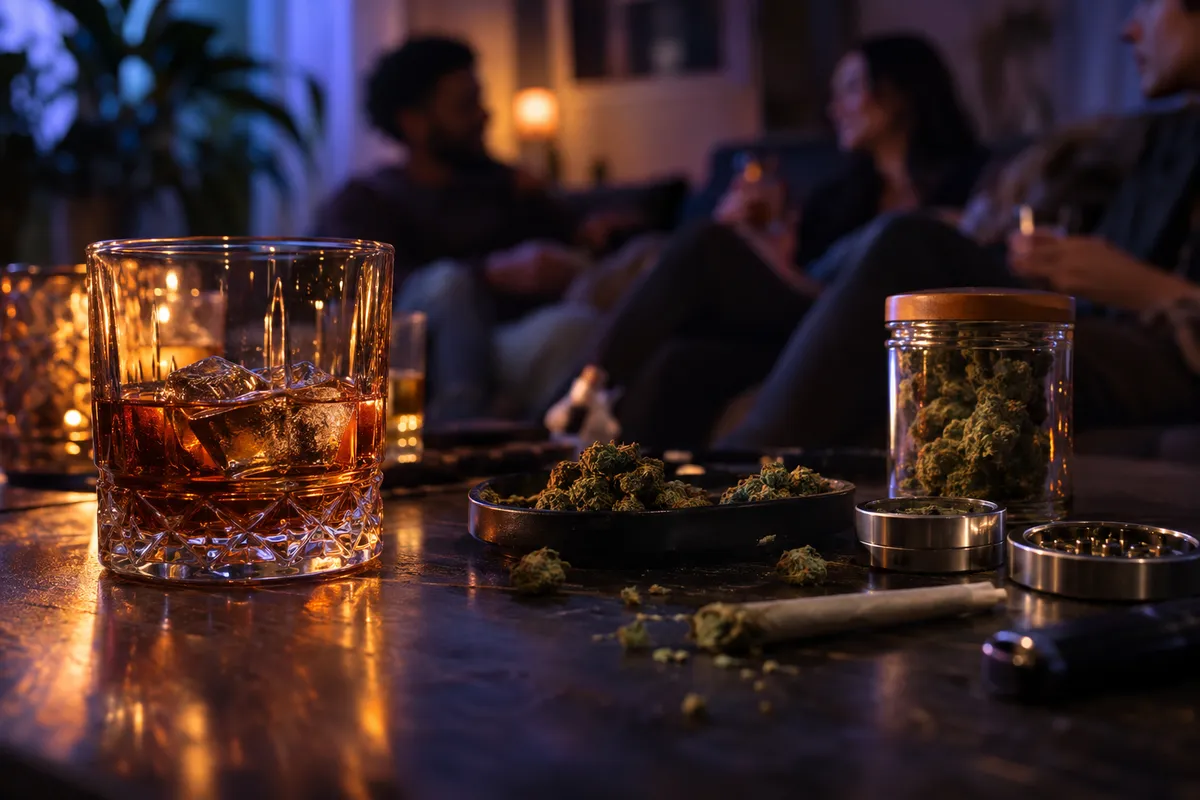
A drink in one hand, a joint making the rounds, and suddenly the evening feels very different from what you planned: that’s the territory people call crossfading. Mixing weed and alcohol can sound like simply combining two familiar experiences, but the result isn’t necessarily familiar - or predictable - even if you’ve used each separately before. Understanding what “crossfaded” means, why timing matters, and where common advice falls apart can help you make more informed choices without relying on party folklore, a friend’s tolerance, or the famously unreliable measurement known as “just a little.”
What does crossfading mean when mixing weed and alcohol?
Crossfading means experiencing the effects of cannabis and alcohol at the same time. Someone who is “crossfaded” is both high and drunk to some degree, although the term doesn’t describe a specific amount, intensity, or ratio.
It’s slang, not a standardized category. One person might use it to describe having a beer and smoking cannabis during the same evening; another might mean being heavily intoxicated from both. That ambiguity matters because the label tells you very little about what someone consumed or how impaired they are.
The overlap also doesn’t require using both substances at exactly the same moment. An edible taken earlier can still be active when someone starts drinking later. Likewise, finishing a drink doesn’t mean its effects have ended before cannabis enters the picture.
Here’s the short comparison:
| Situation | What it means | What it doesn’t establish |
|---|---|---|
| Cannabis alone | Cannabis effects without alcohol in the mix | That driving or other demanding activities are safe |
| Alcohol alone | Alcohol effects without cannabis in the mix | That feeling confident means being unimpaired |
| Crossfading | Cannabis and alcohol effects overlap | A predictable experience or standard level of intoxication |
| “Greening out” | Informal slang for an unpleasant cannabis experience | That alcohol was necessarily involved |
Crossfading and greening out aren’t interchangeable. People sometimes use them as though they mean the same thing, but crossfading describes the combination; greening out describes an unpleasant experience. Neither term is precise enough to explain someone’s condition by itself.
The combination is less predictable than it sounds
The biggest misconception about mixing weed and alcohol is that the experience works like simple addition: familiar cannabis effects plus familiar alcohol effects equals a familiar evening. In practice, the combination can feel different from either substance alone.
People may notice dizziness, nausea, difficulty concentrating, poor coordination, or a stronger sense of intoxication than expected. Not everyone experiences the same effects, and an experience that felt manageable once doesn’t guarantee the next one will.
Several variables make comparisons tricky:
- Cannabis product and potency: Flower, concentrates, and edibles aren’t interchangeable.
- Alcohol amount and strength: A cocktail isn’t a standardized unit just because it arrives in one glass.
- Timing: Effects can overlap differently depending on when each substance was consumed.
- Consumption pace: Repeated drinks or cannabis use can make it difficult to judge what is still taking effect.
- Setting: Crowds, noise, unfamiliar surroundings, and social pressure can complicate an already confusing experience.
Tolerance adds another wrinkle. Being accustomed to cannabis doesn’t establish how someone will respond to cannabis combined with alcohol. The same goes for being an experienced drinker.
Consider two evenings involving “one drink and some weed.” One might involve a measured serving and a labeled product; the other might involve a generously poured cocktail and an unfamiliar concentrate. The description sounds identical. The actual inputs are anything but.
The practical takeaway isn’t to find a perfect formula. It’s to recognize that familiarity with the ingredients doesn’t make the combination predictable.
Order and timing do not create a reliable workaround
You’ve probably heard some version of “weed before beer” or its rhyming counterpart. Catchy? Absolutely. A dependable safety rule? No.
The order of consumption can influence the experience, but no sequence makes mixing cannabis and alcohol reliably safe. Alcohol first may make subsequent cannabis effects feel stronger than expected, while using cannabis first doesn’t prevent someone from becoming overly intoxicated after drinking. A rhyme cannot account for potency, serving size, timing, or individual response.
Edibles introduce a particularly easy timing mistake: assuming that little or no noticeable effect means nothing is happening. Their effects are delayed compared with inhaled cannabis and can last considerably longer. Drinking during that waiting period adds another variable before the edible’s full effects are clear.
Picture someone taking an edible before dinner, deciding it “isn’t doing much,” and having drinks with the meal. Later, the cannabis effects become more noticeable while the alcohol is still part of the picture. That’s overlapping timing - not necessarily a mysterious reaction to a particular strain.
There also isn’t a universal waiting interval that guarantees the substances won’t overlap. Product differences and individual variability make blanket countdowns misleading.
Be skeptical of advice that promises control through:
- A supposedly ideal order.
- A fixed number of minutes between substances.
- A particular strain name.
- A personal rule borrowed from someone with different habits.
These shortcuts replace uncertainty with confidence, not necessarily with useful information.
Clear plans beat improvised limits
The most straightforward way to avoid crossfading is not to combine cannabis and alcohol. Choosing one - or neither - removes the uncertainty introduced by mixing them.
That decision is easier before a social event than halfway through one. “I’m not mixing tonight” is a clearer boundary than “I’ll see how I feel,” especially when drinks are being topped up and cannabis is being passed around.
A few practical plans can keep the evening from becoming a guessing game:
Arrange transportation in advance. Don’t drive after using cannabis, alcohol, or both. Feeling functional isn’t a reliable test of driving ability, and a tracking app cannot certify that you’re safe to drive.
Know what’s being offered. An unlabeled edible, an unfamiliar vape, or a communal cocktail makes it harder to know what you consumed. It’s reasonable to decline something when the contents or strength are unclear.
Make opting out ordinary. You don’t owe anyone a dramatic explanation. “I’m sticking with this” is a complete sentence, even if the group has appointed an unofficial Director of Having Another.
Avoid turning the evening into an experiment. Trying to discover your personal crossfading limit isn’t a dependable way to establish a safe boundary.
If you already track cannabis use, session logging can help preserve details such as the product, method, amount, timing, and your notes. Recording alcohol use alongside those notes provides context; it doesn’t turn the record into a dosing recommendation.
An uncomfortable experience is not a challenge to push through
If an evening starts feeling unpleasant, the goal isn’t to prove you can handle more. Stop adding cannabis or alcohol, step away from social pressure, and let a trusted sober person know what’s happening.
A quieter, familiar place can make it easier to communicate and keep track of the situation. Avoid driving, cycling in traffic, swimming, cooking over an open flame, or attempting other activities where confusion or poor coordination could create immediate danger.
Be wary of supposed quick fixes. Coffee, a cold shower, or a large meal doesn’t reliably reverse intoxication. Feeling more awake is not the same thing as being unimpaired, and adding another substance to “balance things out” introduces more uncertainty.
If someone is difficult to wake, has trouble breathing, has a seizure, or loses consciousness, contact emergency services immediately. Don’t assume they only need to sleep it off. Tell responders what is known about the substances and timing rather than relying on the word “crossfaded.”
Later, once the situation has passed, useful reflection is specific rather than judgmental:
- What products were involved?
- Were serving sizes known or guessed?
- Did consumption happen faster than intended?
- Was an edible still taking effect when drinking began?
- Did social pressure override an earlier decision?
A single unpleasant evening doesn’t establish a universal rule about a product. Looking across multiple records is more useful, and this guide to spotting patterns in cannabis consumption data explains how to distinguish recurring observations from isolated experiences.
Better context supports more deliberate choices
Crossfading means cannabis and alcohol effects overlap - not that there’s a predictable balance between them. Order, experience, and confidence don’t provide a reliable shortcut around that uncertainty, and choosing not to mix is the simplest way to avoid the combination.
The useful habit is paying attention without treating every session like a laboratory experiment. Know what you consumed, notice the surrounding circumstances, and don’t mistake a previous experience for a guarantee.
DankLog’s session logging and personal notes can help you keep that context together over time. A clear record won’t make mixing substances safe, but it can replace fuzzy recollections with something more useful: an honest account of your choices and experiences.