What Is Decarboxylation?
Decarboxylation is the chemical process that converts THCA (tetrahydrocannabinolic acid) in raw cannabis into THC (tetrahydrocannabinol), the compound that produces psychoactive effects. Raw cannabis does not get you high because THCA is not psychoactive. Heat removes a carboxyl group (COOH) from the THCA molecule, transforming it into active THC.
When you smoke or vaporize cannabis, decarboxylation happens instantly from the flame or heating element. But when you cook with cannabis - making cannabutter, canna-oil, tinctures, or any edible - you need to decarb the flower first in the oven before infusing it into fat.
Skip this step and your edibles will have little to no effect, regardless of how much flower you use.
The Optimal Decarb Temperature
240°F (115°C) for 40 minutes is the standard that produces the best balance of potency and reliability for home use.
At this temperature and time, approximately 88% of THCA converts to active THC. The remaining 12% is lost to incomplete conversion and minor heat degradation.
Why 240°F Specifically?
The THCA molecule begins losing its carboxyl group at around 220°F, but the reaction happens slowly at that temperature. At 240°F, the conversion rate hits a sweet spot: fast enough to complete in under an hour, slow enough to avoid significant THC degradation. Go much higher and you start destroying the THC you just activated.
Decarboxylation Temperature Chart
| Temperature | Time | THCA→THC Conversion | Best For |
|---|---|---|---|
| 220°F (105°C) | 45-60 min | ~80-85% | Terpene preservation, flavor-focused edibles |
| 240°F (115°C) | 40 min | ~88% | Standard cannabutter, most edibles |
| 250°F (121°C) | 30 min | ~85-88% | Faster decarb, slight terpene loss |
| 275°F (135°C) | 15-20 min | ~80% | Quick decarb, noticeable terpene/flavor loss |
| 300°F+ (150°C+) | Any | THC degrades rapidly | Avoid this range entirely |
The Terpene Trade-Off
Higher temperatures decarb faster but destroy terpenes - the aromatic compounds responsible for each strain’s unique flavor and aroma. Terpenes also contribute to the entourage effect, where cannabinoids and terpenes work together to shape your experience.
If you are making edibles where flavor matters (infused drinks, cooking with terpenes, gourmet dishes), consider the lower 220°F method. If maximum potency is your goal and flavor is secondary, stick with 240°F.
Step-by-Step Decarboxylation
What You Need
- Cannabis flower (any amount)
- Baking sheet
- Parchment paper
- Oven thermometer (strongly recommended)
- Kitchen timer
The Process
-
Preheat oven to 240°F (115°C). Use an oven thermometer to verify - most home ovens are off by 10-25°F, which can significantly affect results at these precise temperatures.
-
Break up the flower into pea-sized pieces by hand. Do not grind it fine in a grinder. Fine powder increases surface area exposure to heat, which degrades more THC and pushes chlorophyll into your final product.
-
Spread in a single layer on a parchment-lined baking sheet. Pieces should not overlap.
-
Bake for 40 minutes. Stir gently every 10 minutes by shaking the tray to ensure even heat distribution.
-
Remove and cool for 10 minutes before handling. The flower should look slightly darker (light brown/golden) and smell toasted. If it looks dark brown or black, your oven was too hot.
Signs of Proper Decarb
- Color shifts from green to light golden-brown
- Texture becomes dry and crumbly
- Smell is toasty, not burnt
- Flower breaks apart easily between fingers
Once your flower passes these checks, it is ready for infusion. If you are making butter, head to our complete how to make cannabutter guide for ratios, simmer times, and straining tips.
Signs of Over-Decarb
- Dark brown or black color
- Harsh, burnt smell
- Brittle, ash-like texture
- Significant potency has been lost
Common Decarb Methods Compared
Oven (Standard)
The most accessible method. Works well if you verify your oven temperature with a thermometer.
Pros: Simple, no special equipment Cons: Oven temperature fluctuations, strong smell, uneven heating in some ovens
Sous Vide (Most Precise)
Seal ground cannabis in a vacuum bag and submerge in a water bath at 203°F (95°C) for 60-90 minutes.
Pros: Exact temperature control, no smell, most consistent results Cons: Requires sous vide equipment, longer process, lower temperature means longer time needed
Mason Jar in Oven
Place ground cannabis in a mason jar (lid loosely on), set in oven at 240°F for 40 minutes.
Pros: Contains smell, easy cleanup, reusable Cons: Glass can crack if temperature changes are rapid - always place jar in cold oven and heat together
Instant Pot / Pressure Cooker
Seal cannabis in a mason jar, place on trivet in pressure cooker with water, cook on high pressure for 40 minutes.
Pros: Virtually no smell, consistent temperature Cons: Timing varies by device, less tested than oven method
What Happens After Decarb
Decarboxylated cannabis is ready for infusion into a fat or solvent:
- Cannabutter: Simmer decarbed flower in butter at 160-180°F for 2-3 hours
- Canna-oil: Same process using coconut oil or olive oil
- Tincture: Soak decarbed flower in high-proof alcohol for weeks (cold method) or hours (warm method)
- Direct consumption: Decarbed flower can be eaten directly (mixed into yogurt, sprinkled on food) though the taste is strong
Regardless of the method, keep in mind that edibles made from decarbed cannabis take 45-90 minutes to kick in and last 4-8 hours - significantly longer than smoking or vaping.
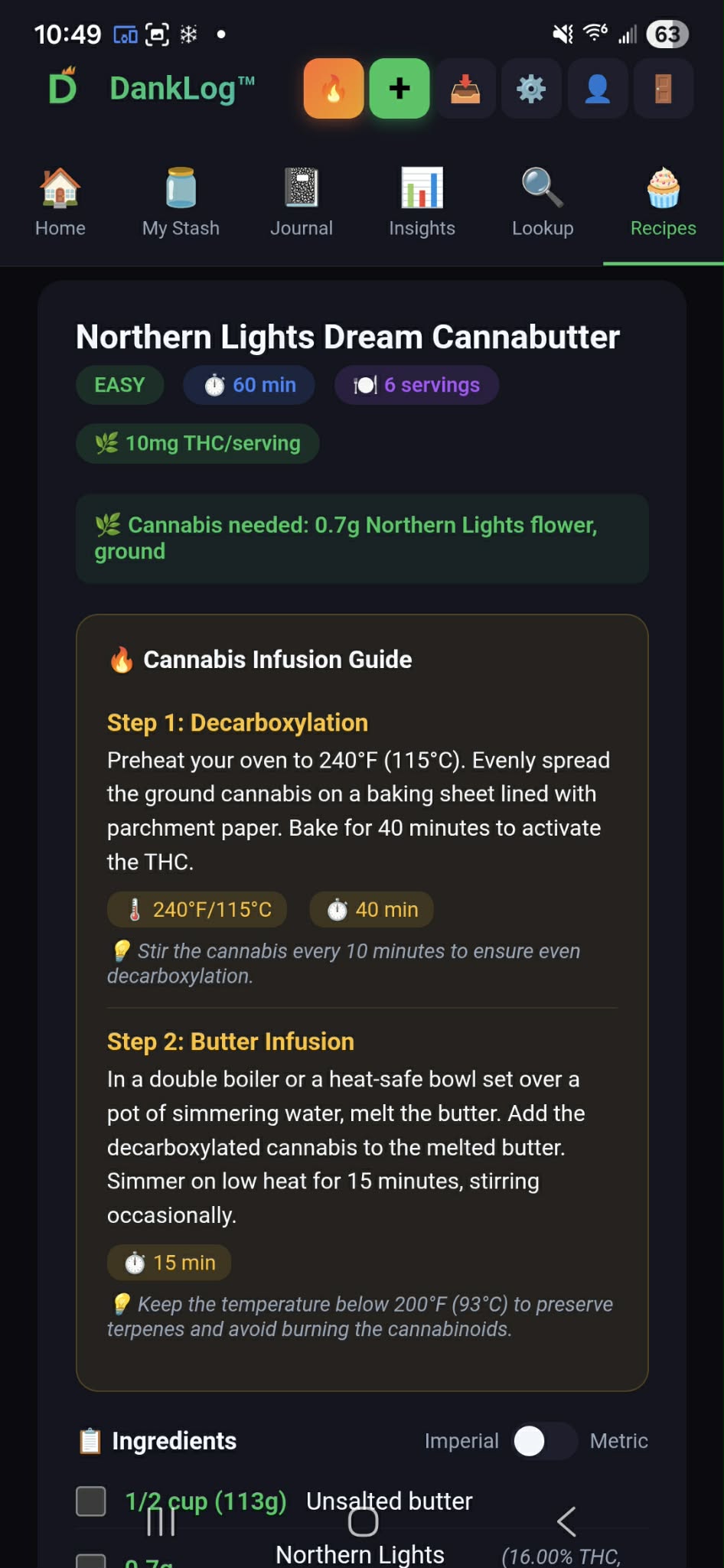
Let the app do the math. DankLog’s Recipe Wizard includes built-in decarb and infusion guides with every recipe it generates. Select your strain, pick a recipe, and get exact temperatures, times, and flower amounts calculated from your stash’s actual THC percentage.
Does Decarb Temperature Affect the High?
Yes, but not in the way most people think.
At standard decarb temperatures (220-250°F), the primary conversion is THCA→THC. But at higher temperatures or longer times, a secondary conversion begins: THC→CBN (cannabinol). CBN is mildly psychoactive and known for sedative effects.
This means:
- Lower temp / shorter time = more THC, more energetic/cerebral effect
- Higher temp / longer time = some THC converts to CBN, more sedative/body effect
If you want the most alert, heady edible experience, decarb at 220°F. If you want something more sedating (for sleep or deep relaxation), you could intentionally decarb at a slightly higher temperature (250-260°F) for 45 minutes to convert some THC to CBN. This is an advanced technique - for most people, the standard 240°F/40min method is the right call.
Frequently Asked Questions
What temp do you decarb weed before making butter?
240°F (115°C) for 40 minutes is the standard. This converts approximately 88% of THCA to active THC, which is optimal for cannabutter. After decarbing, you infuse the flower into butter at a lower temperature (160-180°F) for 2-3 hours.
Can you decarb too long?
Yes. Extended time at decarb temperatures continues to degrade THC, converting it to CBN and eventually breaking it down further. At 240°F, 40 minutes is the sweet spot. Going beyond 60 minutes at this temperature starts to noticeably reduce potency.
Do you have to decarb before making edibles?
Yes, if you want psychoactive effects. Raw cannabis contains THCA, which is not psychoactive. The infusion temperatures used in making cannabutter or canna-oil (160-180°F) are too low for efficient decarboxylation. The oven step is required.
Does decarbing smell?
Yes, significantly. The process releases terpenes and other volatile compounds, creating a strong cannabis odor that can linger for hours. The mason jar and sous vide methods significantly reduce smell. You can also place a pan of water with cinnamon sticks in the oven alongside your cannabis to help mask the odor.
Can you decarb in a microwave?
Not recommended. Microwaves heat unevenly, creating hot spots that can destroy THC in some areas while leaving other areas unconverted. The lack of temperature control makes consistent results nearly impossible.
What is the decarb temp and time for cannabutter?
Decarb at 240°F (115°C) for 40 minutes before making cannabutter. This converts approximately 88% of THCA to active THC. After decarbing, infuse the flower into butter at a lower temperature of 160-180°F for 2-3 hours. The decarb step and the infusion step use different temperatures - both are critical for potent cannabutter.
What temperature activates CBD?
CBD (cannabidiol) decarboxylates at a slightly higher temperature than THC. The optimal range is 245-250°F (118-121°C) for 60-90 minutes. CBDA converts to CBD more slowly than THCA converts to THC, so a longer time is needed. If your flower is high in CBD and you want to preserve both CBD and THC, decarb at 240°F for 50 minutes as a compromise.